


- 1. Murodov NM (2008) Technological and mechanical basis of energy-saving means for basic tillage Diss doc technSci 250.
- 2. Muradov S (2023) Research of Working Bodies for Uncomplacing the Underground Layer of Soil. International Scientific Conference on Agricultural Machinery Industry “Interagromash”, XV International Scientific Conference “Interagromash 2022”, Lecture Notes in Networks and Systems book series 574: 1099-1108.
- 3. MuradovShM (2001) Justification of the parameters of the working bodies for loosening the subsoil layer without compacting the bottom of the furrow. Dissertation for Candidate of Technical Sciences Sci 129.
- 4. Mustafaevich MS (2020) Results of studies of the impact of agricultural tractors and machines on soil. European Journal of Molecular & Clinical Medicine 7: 834–845.
*Correspondence: PublishedDate: 12 Jun 2024 Citation:
Results of research work on physical and mechanical properties of soil during its main cultivation
are presented in this article. It is established that physical and mechanical properties of soil act as
defining factors in design development of working elements and justification of operating modes of
soil-cultivating machines. They mainly depend on the type and texture of soil.
Keywords: Polishing the soil; Two layers of plow; Up and down forms; Dumper of surface; Takyr soil- infertile hard soil.
Research has established that the physical and mechanical properties of the soil are the
determining factors in creating the design of working bodies and in justifying the operating modes of
tillage machines. They mainly depend on the type and mechanical composition of the soil.One of the
main factors influencing soil cultivation from the point of view of agricultural technology and energy,
regardless of the type of mechanical composition, is the humidity, hardness and density of the soil
of the cultivated horizon.The moisture content of the soil greatly influences its mechanical strength
and, therefore, it’s processing. Soils with low moisture content have greater mechanical strength;
during their cultivation, many blocks and large lumps are formed, therefore the traction resistance
of soil-cultivating working bodies is of great importance. Due to its significant plasticity, wet soil
crumbles and does not stick well to the surface of the working tool. The soil moisture and hardness
were studied under typical conditions against the background of old arable land with long-standing
irrigation, grown from cotton and alfalfa, while the soil moisture and hardness were determined using
standard methods. The hardness of the soil was determined using a modern manual hardness tester
(Dutch design), and various conical tips were used depending on the condition of the soil. The average
error of the device reading does not exceed ± 8% [1]. From the data obtained [2-4], soil moisture and
hardness largely depend on the agrotechnical background and horizon depth (Table 1).
Depending on the agrotechnical background and the predecessor, changes in humidity and soil
moisture and hardness differ from each other in depth, for example, in a cotton field in the arable
layer at a depth of 0-30 sm, soil moisture increases from 12.32 to 14.83%, while the soil hardness is
1.65 to 2.72 MPa, further, at a depth of 30-50 cm, soil moisture decreases to 10.05%, and soil hardness
increases sharply to 6.25 MPa. In an alfalfa field, soil moisture in horizons of 0-50 cm ranges from
11.25 to 16.81%, while soil hardness at a depth of 0-30 cm increases from 2.18 to 3.27 MPa, and
subsequently with increasing layer depth soil hardness increases to 5.65 MPa. During the period
of main tillage, soil moisture ranges from 10.05 to 14.83%, instead of the optimal 17-18%, which
increases soil hardness and requires additional energy costs for tillage.From this we can conclude that
the depth of soil hardness largely depends on the predecessor and the number of agrotechnical tillage
methods.In addition to the hardness of the soil, the development of plants, the yield of cotton and
other agricultural crops is influenced by its density. The study of soil density in old cotton fields was
carried out at a groundwater depth of 1.8-2.0 m.
The soils are meadow, irrigated for a long time, the mechanical composition is medium loamy,
slightly saline.
Determination of soil density depending on the initial moisture content in various soil types is
It has been established that an increase in soil density in the underlying horizons undoubtedly has a negative
effect on water permeability and the value of field moisture capacity of the soil, as well as on the yield of agricultural
crops. The density of the soil also depends on their type and moisture content.
In desert-sandy soils, an increase in their density in the horizon of 20 cm and below indicates a low soil
moisture content, which is related to coarse and difficult-to-cultivate soils.
It has been established that in the sub-arable horizon, where the soil density is usually too high, working tools
should be used that prevent the formation of a compacted soil layer.
Changes in the mechanical strength of takyr and light soil gray soil for compression and rupture due to their
moisture content were studied, the results of which are given in Table 2.
It should be noted that the tensile strength of light soil gray soil is significantly greater than that of takyr
soil. The compression force also changes according to the same pattern. Light soil gray soil has a slightly higher
compressive stress limit than takyr soil.
At the same moisture content, the compressive stress of the studied soils is 5-6 times higher than the tensile
strength.
Thus, based on the data presented, we can come to the conclusion that these soils have very high mechanical
strength at low humidity and their processing requires high energy consumption.
Physico-mechanical Properties of Soil during the Treatment Period

OPEN ACCESS
Murad Ali Khan, Department of Computer Engineering, Jeju National University, Jeju 63243, Republic of Korea.
Murad Ali Khan. Advancing Sustainable Power: A Comprehensive Review of Technologies and Strategies for
Green Electricity Production. Collect J Chem Eng. 2024; 1: ART0039.

Abstract
Introduction
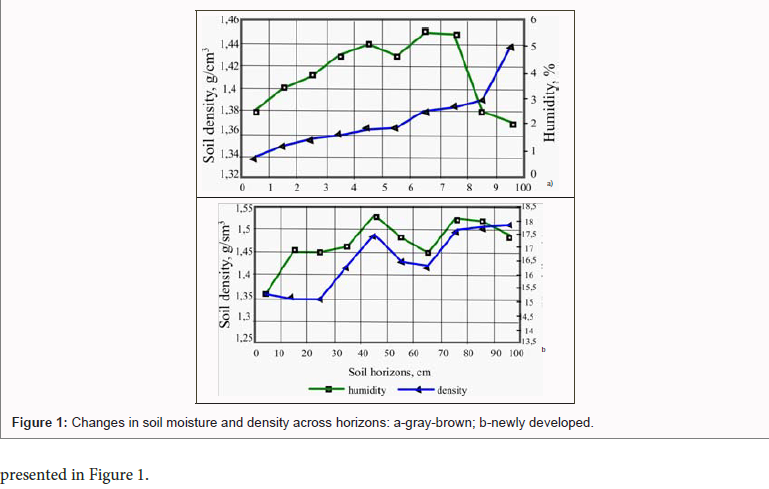
Presented in Figure 1.
The data obtained show that in all the studied soils, the horizons (0-30 cm) have a satisfactory density in the
range of 1.3-1.35 g/cm³, with increasing depth of cultivation of the horizons, the soil density increases.
References